Monday, April 20, 2020

A NAṢ A WEEK - 26 SYA'ABAN 1441H

Abu Huraira reported: The Messenger of Allah, peace and blessings be upon him, said when the month of Ramadan arrived, “The month of Ramadan has come, a blessed month in which Allah Almighty has obligated you to fast. In it the gates of the heavens are opened, and in it the gates of Hellfire are closed, and in it the devils are chained, and in it is a night that is better than a thousand months. Thus, whoever is deprived of its good is truly deprived.” [Source: Musnad Aḥmad 7108. Grade: Sahih (authentic) according to Ahmad Shakir]

عَنْ أَبِي هُرَيْرَةَ قَالَ لَمَّا حَضَرَ رَمَضَانُ قَالَ رَسُولُ اللَّهِ صَلَّى اللَّهُ عَلَيْهِ وَسَلَّمَ قَدْ جَاءَكُمْ رَمَضَانُ شَهْرٌ مُبَارَكٌ افْتَرَضَ اللَّهُ عَلَيْكُمْ صِيَامَهُ تُفْتَحُ فِيهِ أَبْوَابُ الْجَنَّةِ وَيُغْلَقُ فِيهِ أَبْوَابُ الْجَحِيمِ وَتُغَلُّ فِيهِ الشَّيَاطِينُ فِيهِ لَيْلَةٌ خَيْرٌ مِنْ أَلْفِ شَهْرٍ مَنْ حُرِمَ خَيْرَهَا قَدْ حُرِمَ
7108 مسند أحمد باقي مسند المكثرين]
[12/134 المحدث أحمد شاكر خلاصة حكم المحدث إسناده صحيح في مسند أحمد

Source (Credit To):

Monday, April 13, 2020

A NAṢ A WEEK - 19 SYA'ABAN 1441H


You who believe, fasting is prescribed for you, as it was prescribed for those before you, so that you may be mindful of God [The English translation of Surah al-Baqarah (2), ayah 183 by Prof. Muhammad Abdel Halem].

Compare Translations:


Source (Credit To):
https://quran.com/2/183

Monday, April 6, 2020

A NAṢ A WEEK - 12 SYA'ABAN 1441H

Abu Huraira reported: The Prophet, peace and blessings be upon him, said, “Allah did not send down any disease but that he also sent down the cure.” [Source: Ṣaḥīḥ al-Bukhārī 5354. Grade: Sahih (authentic) according to Al-Bukhari].

Ibn al-Qayyim said, “This is generally true for diseases of the heart, the spirit, the body, and their cures.” [Source: al-Jawāb al-Kāfī 1/8]

عَنْ أَبِي هُرَيْرَةَ رَضِيَ اللَّهُ عَنْهُ عَنْ النَّبِيِّ صَلَّى اللَّهُ عَلَيْهِ وَسَلَّمَ قَالَ مَا أَنْزَلَ اللَّهُ دَاءً إِلَّا أَنْزَلَ لَهُ شِفَاءً
5354 صحيح البخاري كتاب الطب باب ما أنزل الله داء إلا أنزل له شفاء]
وقال ابن القيم وَهَذَا يَعُمُّ أَدَوَاءَ الْقَلْبِ وَالرُّوحِ وَالْبَدَنِ وَأَدْوِيَتِهَا
[1/8 الجواب الكافي لمن سأل عن الدواء الشافي

Source (Credit To):

Monday, March 30, 2020

A NAṢ A WEEK - 5 SYA'ABAN 1441H

(One Day) you will remember what I am saying to you now, So I commit my case to God: God is well aware of His servants.’ [The English translation of Surah Ghafir (40), ayah 44 by Prof. Muhammad Abdel Halem].

Compare Translations:

Source (Credit To):

فَسَتَذْكُرُونَ مَا أَقُولُ لَكُمْ ۚ وَأُفَوِّضُ أَمْرِي إِلَى اللَّهِ ۚ إِنَّ اللَّهَ بَصِيرٌ بِالْعِبَادِ - 40:https://quran.com/40

فَسَتَذْكُرُونَ مَا أَقُولُ لَكُمْ ۚ وَأُفَوِّضُ أَمْرِي إِلَى اللَّهِ ۚ إِنَّ اللَّهَ بَصِيرٌ بِالْعِبَادِ - 40:44

Monday, March 23, 2020

A NAṢ A WEEK - 28 RAJAB 1441H

Abu Mas’ud reported: The Messenger of Allah, peace and blessings be upon him, said, “Verily, among the words people obtained from the prophets are this: If you feel no shame, do as you wish.” [Source: Ṣaḥīḥ al-Bukhārī 3296. Grade: Sahih (authentic) according to Al-Bukhari]

Ibn Rajab said, “The scholars interpret this saying in two ways. First, that it is a command of caution and warning, meaning if there is no shame, do as you wish, for Allah will repay you accordingly… Second, that it is a command of description, meaning that whoever does not have shame will do as he wishes, for it is shame that prevents evil deeds.” [Source: Jāmi’ al-Ulūm wal-Ḥikam 20]

عن أبي مسعود عقبة قَالَ قَالَ النَّبِيُّ صَلَّى اللَّهُ عَلَيْهِ وَسَلَّمَ إِنَّ مِمَّا أَدْرَكَ النَّاسُ مِنْ كَلَامِ النُّبُوَّةِ إِذَا لَمْ تَسْتَحْيِ فَافْعَلْ مَا شِئْتَ

[3296 صحيح البخاري كتاب أحاديث الأنبياء باب حديث الغار]

قال ابن رجب وَأَهْلُ هَذِهِ الْمَقَالَةِ لَهُمْ طَرِيقَانِ أَحَدُهُمَا أَنَّهُ أَمْرٌ بِمَعْنَى التَّهْدِيدِ وَالْوَعِيدِ وَالْمَعْنَى إِذَا لَمْ يَكُنْ حَيَاءٌ فَاعْمَلْ مَا شِئْتَ فَاللَّهُ يُجَازِيكَ عَلَيْه … وَالطَّرِيقُ الثَّانِي أَنَّهُ أَمْرٌ وَمَعْنَاهُ الْخَبَرُ وَالْمَعْنَى أَنَّ مَنْ لَمْ يَسْتَحْيِ صَنَعَ مَا شَاءَ فَإِنَّ الْمَانِعَ مِنْ فِعْلِ الْقَبَائِحِ هُوَ الْحَيَاءُ
[20 جامع العلوم والحكم]

Monday, March 16, 2020

A NAṢ A WEEK - 21 RAJAB 1441H


Those who spend (freely) whether in prosperity or in adversity; who restrain anger and pardon (all) men; for Allah loves those who do good.  453 [The English translation of Surah 3 - Aali 'Imran, ayah 134 by Abdullah Yusuf Ali].

Note:
453 - Another definition of the righteous (vv. 134-35). So far from grasping material wealth, they give freely, of themselves and their substance, not only when they are well-off and it is easy for them to do so, but also when they arc in difficulties, for other people may be in difficulties at the same time. They do not get ruffled in adversity, or get angry when other people behave badly, or their own good plans fail. On the contrary they redouble their efforts. For the charity-or good deeds-is all the more necessary in adversity. And they do not throw the blame on others. Even where such blame is due and correction is necessary, their own mind is free from a sense of grievance, for they forgive and cover other men's faults. This as far as other people are concerned. But we may be ourselves at fault, and perhaps we brought some calamity on ourselves. The righteous man is not necessarily perfect. In such circumstances his behaviour is described in the next verse.

Compare Translations:

Source (Credit To):
http://www.alim.org/library/quran/ayah/compare/3/134

Monday, March 9, 2020

A NAṢ A WEEK - 14 RAJAB 1441

Ibn Umar reported: The Prophet, peace and blessings be upon him, said, “Listening to and obeying the leader is an obligation upon a Muslim, whether he likes it or dislikes it, as long as he is not commanded to disobey Allah. If he is commanded to disobey Allah, there is no listening or obedience.” [Source: Ṣaḥīḥ al-Bukhārī 2796, Ṣaḥīḥ Muslim 1839. Grade: Muttafaqun Alayhi (authenticity agreed upon) according to Al-Bukhari and Muslim]

عَنْ عَبْدِ اللَّهِ رَضِيَ اللَّهُ عَنْهُ عَنْ النَّبِيِّ صَلَّى اللَّهُ عَلَيْهِ وَسَلَّمَ قَالَ السَّمْعُ وَالطَّاعَةُ عَلَى الْمَرْءِ الْمُسْلِمِ فِيمَا أَحَبَّ وَكَرِهَ مَا لَمْ يُؤْمَرْ بِمَعْصِيَةٍ فَإِذَا أُمِرَ بِمَعْصِيَةٍ فَلَا سَمْعَ وَلَا طَاعَةَ 

6725 صحيح البخاري كتاب الأحكام باب السمع والطاعة للإمام ما لم تكن معصية ]
[1839 صحيح مسلم كتاب الإمارة باب وجوب طاعة الأمراء في غير معصية وتحريمها في المعصية

Source (Credit To):

Monday, March 2, 2020

DIRECTOR'S TARBIYYAH: HONOUR ISDEV TRADITIONS


When ISDEV Director, Dr Shahir Akram speaks, all eyes and ears are attentive.
The Centre for Islamic Development Management Studies (ISDEV), Universiti Sains Malaysia (USM) is a one-of-its-kind research centre. It is steeped in traditions which have been observed since prior to its inception, when ISDEV was still just a virtual centre at the School of Social Sciences, USM. One of the long lasting traditions is the short tazkirah sessions held at every lecture just before the start of the class as well as the monthly ISDEV Director's Tarbiyyah.

The opening slide to ISDEV Dirrector's Tarbiyyah.
For the month of February 2020, the topic of choice by ISDEV Director, Dr Shahir Akram Hassan for the ISDEV Director Tarbiyyah's slot held on the 21st instant was on "Preserving ISDEV Traditions". He started his tarbiyyah with an activity through mentimeter.com and requested all to list at list five ISDEV traditions. The activity proved very fruitful as scores of answers were given among which the popular ones are Tuesdays Study Sessions and congregational Solat Hajat pre-viva voce.
Dr Shahir Akram, elaborating further on the three basic ISDEV traditions.
Dr Shahir agreed with the findings from the activity held but he said that among the many traditions that are mentioned in the list there are three basic traditions that he wants all ISDEV members to honour, observe and follow closely at all times, The three are (1) KEEPING TIME - be punctual at all times whether for  ISDEV programme and activities or for other programme; (2) ALIGNMENT (keselarasan) of thoughts and actions which can be also translated in the outward appearance and last but not the least (3) SHARING GOOD NEWS which is part of the sunnah of Rasulullah SAW.


A NAṢ A WEEK - 7 RAJAB 1441H


O ye that believe! betray not the trust of Allah and the apostle nor misappropriate knowingly things entrusted to you.  1200  [The English translation of Surah 8, al-Anfaal ayah 27 by Abdullah Yusuf Ali]

Note:
1200 - Trusts may be of various kinds: (1) property, goods, credit, etc.; (2) plans, confidences, secrets, etc.; (3) knowledge, talents, opportunities, etc., which we are expected to use for our fellowmen. Men may betray the trust of Allah and His Prophet by misusing property, or abusing the confidence reposed in them, or the knowledge or talents given to them. On that special occasion, when the plans for the protection of Allah's worshippers against annihilation were of special importance, the Prophet's trust and confidence had to be guarded with special care. Occasions for scrupulously respecting the trust and confidence of our fellow-men occur every day in our life, and few of us can claim perfection in this respect. Hence the special distinction of the Prophet of Allah, who earned the title of Al-Amin, the one who was true to every trust reposed in him. 

Compare Translations:

Source (Credit To):
http://www.alim.org/library/quran/ayah/compare/8/27

Monday, February 24, 2020

A NAṢ A WEEK - 30 JAMADIL AKHIR 1441H

Abu Huraira reported: The Prophet, peace and blessings be upon him, said, “Verily, Allah has written for the son of Adam his portion of adultery which he will inevitably commit: the adultery of the eyes is a lustful look, the adultery of the tongue is lustful speech. The soul craves and yearns; the passions will affirm or deny.” [Source: Ṣaḥīḥ al-Bukhārī 6238, Ṣaḥīḥ Muslim 2657. Grade: Muttafaqun Alayhi (authenticity agreed upon) according to Al-Bukhari and Muslim].

عَنْ أَبِي هُرَيْرَةَ أَنَّ النَّبِيَّ صلى الله عليه وسلم قَالَ‏ إِنَّ اللَّهَ كَتَبَ عَلَى ابْنِ آدَمَ حَظَّهُ مِنَ الزِّنَى أَدْرَكَ ذَلِكَ لاَ مَحَالَةَ فَزِنَى الْعَيْنَيْنِ النَّظَرُ وَزِنَى اللِّسَانِ النُّطْقُ وَالنَّفْسُ تَمَنَّى وَتَشْتَهِي وَالْفَرْجُ يُصَدِّقُ ذَلِكَ أَوْ يُكَذِّبُهُ
6238 صحيح البخاري كتاب القدر باب وحرام على قرية أهلكناها أنهم لا يرجعون]
[2657 صحيح مسلم كتاب القدر باب كابن آدم له الزنا وغيرها
Source (Credit To):

Monday, February 17, 2020

A NAṢ A WEEK - 23 JAMADIL AKHIR 1441H

"I (Satan) will mislead them and I will create in them false desires; I will order them to slit the ears of cattle and to deface the (fair) nature created by Allah." Whoever forsaking Allah takes Satan for a friend hath of a surety suffered a loss that is manifest.  629   630   631 [The English translation of Surah 4 - an-Nissa', ayah 119 by Abdullah Yusuf Ali].

Notes:
629 - Satan's deceptions are with false desires, false superstitions, and false fears.
630 - Slitting the ears of cattle is just one instance of the superstitions to which men become slaves when they run after false gods. Astrology, magic, and vain beliefs in things that do not exist lead men away from Allah, the one true God. 
631 - To deface the (fair) nature created by Allah; there is both a physical and a spiritual meaning. We see many kinds of defacements practised on men and animals, against their true nature as created by Allah, partly on account of superstition, partly on account of selfishness. Spiritually the case is even worse. How many natures are dwarfed or starved and turned from their original instincts by cruel superstitions or customs? Allah created man pure: Satan defaces the image. 

Compare Translations:

Monday, February 10, 2020

SHARING THEIR EXPERTISE IN LAMPUNG

Safe and sound arrival in Lampung greeted by the academic staff of Universitas Teknokrat Indonesia.
Recently, two lecturers of the Centre for Islamic Development Management Studies (ISDEV), Universiti Sains Malaysia (USM) were in Lampung, Indonesia. They were ISDEV Director, Dr. Shahir Akram Hassan and ISDEV Founder, Professor Dr. Muhammad Syukri Salleh. They were there from 20 until 22 January 2020.
An advertisement on the seminar published in Lampung's Tribune.
Dr Shahir and Prof. Syukri were there to fulfill an invitation to be among the speakers at the International Seminar on Economic Development organised by Universitas Teknokrat Indonesia held on 21 January, 2020.
An excerpt of the article making reference to the experts.
They made the headlines in one of the articles covered by Lampung's local newspapers which provided coverage on the seminar. The seminar's theme was regarding the impact of the digital era on the social and economic development of a nation. The article was posted later that afternoon.
Dr Shahir and Prof Syukri at UIN RIL.
Later in the afternoon on the same day, Dr Shahir and Prof Syukri fulfilled another invitation to speak at the International Lecturer Visit programme. This time around they addressed the academicians and postgraduate students at Universitas Islam Negeri Raden Intan Lampung (UIN RIL) on the development of the Islamic economy in facing the Industrial Revolution 4.0.


A NAṢ A WEEK - 16 JAMADIL AKHIR 1441H

Aisha reported: She asked the Messenger of Allah, peace and blessings be upon him, about pestilence and he said, “It is a punishment which Allah sends upon whoever he wills, but Allah has made it mercy for the believers. Any servant who resides in a town plagued with pestilence while remaining patient and hoping for reward from Allah, knowing that nothing will befall him but what Allah has written, he will be given the reward of a martyr.” [Source: Ṣaḥīḥ al-Bukhārī 5402. Grade: Sahih (authentic) according to Al-Bukhari]

عَنْ عَائِشَةَ أَنَّهَا سَأَلَتْ رَسُولَ اللَّهِ صَلَّى اللَّهُ عَلَيْهِ وَسَلَّمَ عَنْ الطَّاعُونِ فَأَخْبَرَهَا نَبِيُّ اللَّهِ صَلَّى اللَّهُ عَلَيْهِ وَسَلَّمَ أَنَّهُ كَانَ عَذَابًا يَبْعَثُهُ اللَّهُ عَلَى مَنْ يَشَاءُ فَجَعَلَهُ اللَّهُ رَحْمَةً لِلْمُؤْمِنِينَ فَلَيْسَ مِنْ عَبْدٍ يَقَعُ الطَّاعُونُ فَيَمْكُثُ فِي بَلَدِهِ صَابِرًا يَعْلَمُ أَنَّهُ لَنْ يُصِيبَهُ إِلَّا مَا كَتَبَ اللَّهُ لَهُ إِلَّا كَانَ لَهُ مِثْلُ أَجْرِ الشَّهِيدِ
[5402 صحيح البخاري كتاب الطب باب أجر الصابر في الطاعون]

Source (Credit To):

Monday, February 3, 2020

A NAṢ A WEEK - 9 JAMADIL AKHIR 1441H

Said one of the (damsels): "O my (dear) father! engage him on wages: truly the best of men for thee to employ is the (man) who is strong and trusty"...  3355   3356 [The English translation of surah al-Qasas, 28:26 by Abdullah Yusuf Ali]

Notes:
3355 - A little time passes. A guest after all cannot stay for ever. They all feel that it would be good to have him with them permanently. The girl who had given her heart to him had spoken their unspoken thoughts. Why not employ him to tend the flocks? The father was old, and a young man was wanted to look after the flocks. And-there may be other possibilities.
3356 - Strong and trusty: Moses had proved himself to be both, and these were the very qualities which a woman most admires in the man she loves. 

Compare Translations:

Source (Credit To):

Wednesday, January 29, 2020

JANUARY 2020 GREETS ISDEV WITH 3 SUCCESSFUL VIVA

A grateful Nurul Izza (seated centre) with her husband Assoc Prof. Abdul Hafiz (seated right).
Alhamdulillah and its January 2020. A new year for all and the Centre for Islamic Development Management Studies (ISDEV), Universiti Sains Malaysia (USM) is of no exception. For this year, ISDEV is greeted with a series of viva voce for RISDEV (ISDEV Postgraduate students by research) students who had submitted their PhD theses to the Institute of Postgraduate Studies (IPS), USM sometime in the final quarter of 2019. ISDEV received the great good news that one of the PhD theses deserved a noination for the "Best Thesis Award". 
Nurul Izza during her viva session.
The first viva was held on 7 January, 2020. It was held at the Graduate School of Business (GSB) Meeting Room. RISDEV student, Puan Nurul Izza Abdul Aziz had to face her panel of examiners to defend her thesis related to the Concept of Wellbeing for Women in the Workforce's from an Islamic Perspective. Associate Professor Dr Fadzila Azni Ahmad is her main supervisor while Associate Professor Dr Aswati Hamzah is Nurul Izzah's co-supervisor.
Staying true to ISDEV tradition, just before a viva session a congregational solat hajat was done.
Picture taken after the solat hajat at Anjung ISDEV (ISDEV's musolla).
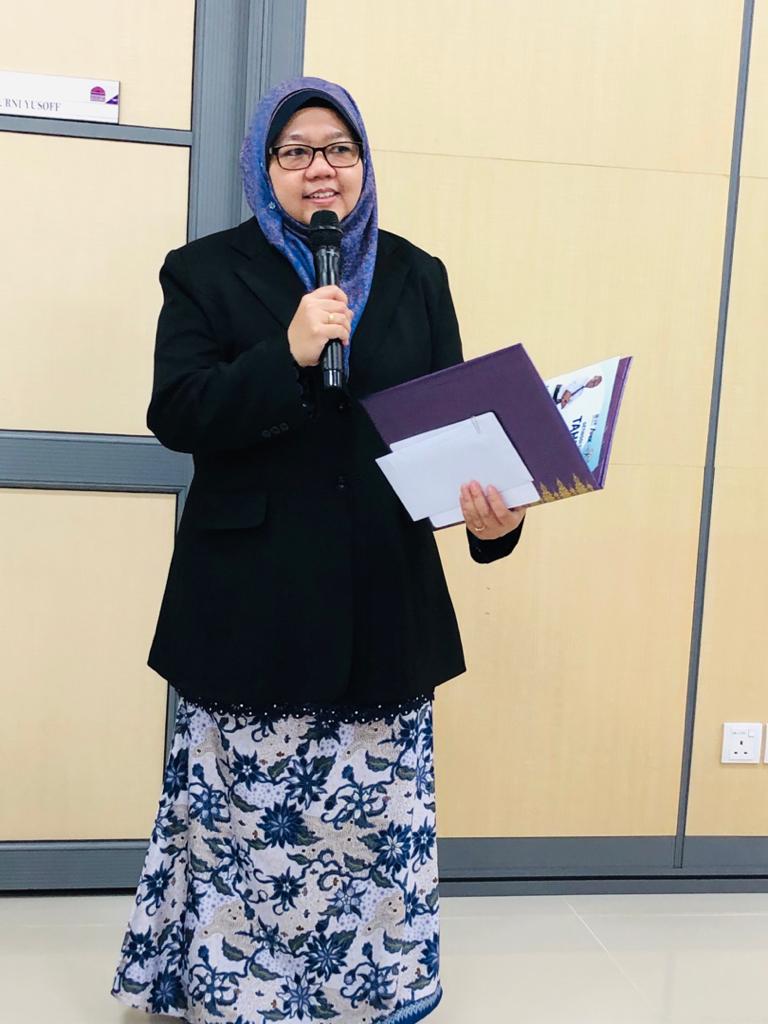
After a gruelling close to 3 hours viva responding to the questions and comments from her External Examiner, Dr Nor 'Azzah Kamri of the Academy of Islamic Studies (API), Universiti Malaya (UM) conveyed by ISDEV Director, Dr Shahir Akram Hassan, and the two internal examiners, Dr Wan Norhaniza Wan Hasan and Dr Murni Yusoff, with Professor Dr Ahmad Sanusi Hassan of School of Housing, Building and Planning (HBP) chairing the whole session, Nurul Izza nonetheless received the jubilant news that she had passed her viva voce.
Another one of ISDEV's viva tradition - conducting a mock viva just a day or two before the real viva voce.
Next in line was Puan Shahirah Said. Her viva voce was held on Friday, 10 January, 2020 also at GSB Meeting Room. Shahirah's PhD thesis was regarding the Philosophy of Halal Sciences based on the Qur'an by means of Tafsir Mawdu'iy (Thematic Exegesis). She embarked on her PhD endeavours with the guidance of Dr. Mohd Shukri Hanapi as her main supervisor while her co-supervisor was Dr. Mohd Syahmir Alias from the School of Humanities (PPIK).
Shahirah during her viva voce.
After a tense and another lengthy viva session, Shahirah's panel of examiners made up of Professor Dr. Engku Ahmad Zaki Engku Alwi from the Faculty of Contemporary Islamic Studies, Universiti Sultan Zainal Abidin (UniSZA) as well as the two internal examiners, Dr. Shahir Akram Hassan and Associate Professor Dr. Fadzila Azni Ahmad both from ISDEV with Professor Dr. Nabsiah Abdul Wahid of GSB chairing the examination session, declared that Shahirah has succeeded in her viva voce. To add to the good news her thesis was nominated for the "Best Thesis Award".
One for the album for Shahirah and her husband (seated left).
The final viva voce in this line up was Wan Nornajwa Wan Othman. Her viva was held on Tuesday 14 January, 2020 at the Social Sciences Conference Room (C23). Her panel of examiners consisted of Professor Ruslan bin Rainis of PPIK as the Chairperson, Associate Professor Dr. Che Zarrina Sa'ari from API UM was the External Examiner while Dr Murni Yusoff and Dr Shahir Akram Hassan were the two internal examiners. 
Wan Nornajwa listens carefully to a question posed by one of the examiners.
Wan Nornajwa had to defend her PhD thesis on Stress Management for Human Wellbeing based on Kitab Hikam but she was able to be fully composed, coherent and calm in explaining her justifications in pursuing the research, the methodologies used and of course her findings throughout the more than two hours session. Wan Nornajwa's main supervisor is Associate Professor Dr Fadzila Azni Ahmad and her co-supervisor is Dr. Rehanah Mohd Zain from School of Health Sciences, USM.
A smiling Wan Nornajwa with her examiners.
Wan Nornajwa too received the good news of her success in passing her viva voce with six months given for her to make the necessary corrections to her Phd Thesis and submit to IPS thereby.
A group photo taken prior to one of the viva sessions.
Alhamdulillah and Heartiest Congratulations to all three RISDEV students!


Monday, January 27, 2020

A NAṢ A WEEK - 2 JAMADIL AKHIR 1441H

Al-Zubayr ibn al-‘Awwam reported: The Messenger of Allah, peace and blessings be upon him, said, “Lurking towards you are the diseases of the nations before you. Envy and hatred are the razor. I do not say they shave hair, but rather they shave the religion. By the one in whose hand is my soul, you will not enter Paradise until you have faith and you will not have faith until you love each other. Shall I tell you what can affirm that for you? Spread peace between yourselves.” [Source: Sunan al-Tirmidhī 2510. Grade: Sahih (authentic) according to Al-Suyuti]

عَنِ الزُّبَيْرِ بْنِ الْعَوَّامِ رَضِيَ اللَّهُ عَنْهُ قَالَ قَالَ رَسُولُ اللَّهِ صَلَّى اللَّهُ عَلَيْهِ وَسَلَّمَ دَبَّ إِلَيْكُمْ دَاءُ الأُمَمِ قَبْلَكُمْ الحَسَدُ وَالبَغْضَاءُ هِيَ الحَالِقَةُ لاَ أَقُولُ تَحْلِقُ الشَّعَرَ وَلَكِنْ تَحْلِقُ الدِّينَ وَالَّذِي نَفْسِي بِيَدِهِ لاَ تَدْخُلُوا الجَنَّةَ حَتَّى تُؤْمِنُوا وَلاَ تُؤْمِنُوا حَتَّى تَحَابُّوا أَفَلاَ أُنَبِّئُكُمْ بِمَا يُثَبِّتُ ذَلِكَ لَكُمْ أَفْشُوا السَّلاَمَ بَيْنَكُمْ
2510 سنن الترمذي كتاب صفة القيامة والرقائق والورع]
[4154 المحدث السيوطي خلاصة حكم المحدث صحيح في الجامع الصغير

Wednesday, January 22, 2020

IT'S NOW ASSOCIATE PROFESSOR DR FADZILA AZNI

An online poster by ISDEV to mark Assoc. Prof. Dr Fadzila Azni's promotion
Alhamdulillah and yes that's true. Dr Fadzila Azni Ahmad is now officially an Associate Professor with the Centre for Islamic Development Management Studies (ISDEV), Universiti Sains Malaysia (USM). So in her formal capacity as a member of the academia and lecturer at ISDEV, she is now to be addressed as Associate Professor Dr Fadzila Azni Ahmad. Her promoton as an Associate Professor took effect on 1 October, 2019 but news of the promotion was officially declared in January this year.
A Congratulary Note from USM's VC.
ISDEV took the opportunity to hold a simple and brief ceremony to celebrate and mark Associate Professor Dr Fadzila Azni's promotion.  
ISDEV Director, Dr Shahir, presenting the Official Documents to Assoc. Prof. Dr Fadzila Azni.
The humble ceremony took place at ISDEV Resource Room on 14 January, 2020 at 3:30pm. ISDEV Director, Dr Shahir Akram Hassan, was there to personally present the official letter confirming her promotion and a Personal Congratulatory Note from USM Vice Chancellor, Professor Faisal Rafiq Mahamd Adikan.
Still as humble and affable as ever - Associate Professor Dr Fadzila Azni.
Associate Professor Dr Fadzila Azni in her short speech expressed her utmost gratitude for the recognition bestowed upon her with this promotion. She also gave her unwavering commitment to strive further for the sake of the ummah in general and ISDEV and USM in particular.

Heartiest Congratulations Associate Professor Dr Fadzila Azni Ahmad!


Monday, January 20, 2020

A NAṢ A WEEK - 24 JAMADIL AWWAL 1441H

We bestowed (in the past) wisdom on Luqman: "Show (thy) gratitude to Allah." Any who is (so) grateful does so to the profit of his own soul: but if any is ungrateful verily Allah is free of all wants worthy of all praise.  3593   3594 [The English translation of surah Luqman, 31:12 by Abdullah Yusuf Ali]

Notes:
3593 - The sage Luqman, after whom this Sura is called, belongs to Arab tradition. Very little is known of his life. He is usually associated with a long life, and his title is Mu'ammar (the long-lived). He is referred by some to the age of the 'Ad people, for whom see n. 1040 to vii. 65. He is the type of perfect wisdom. It is said that he belonged to a humble station in life, being a slave or a carpenter, and that he refused worldly power and a kingdom. Many instructive apologies are credited to him, similar to Aesop's Fables in Greek tradition. The identification of Luqman and Aesop has no historical foundation, though it is true that the traditions about them have influenced each other.
3594-  Cf. xiv. 8. The basis of the moral Law is man's own good, and not any benefit to Allah, for Allah is above all needs, and "worthy of all praise"; i.e., even in praising Him, we do not advance His glory. When we obey His Will, we bring our position into conformity with our own nature as made by Him. 

Compare Translations:
   
Source (Credit To):

Monday, January 13, 2020

A NAṢ A WEEK - 17 JAMADIL AWWAL 1441H

Aisha reported: The Messenger of Allah, peace and blessings be upon him, said, “Verily, Allah is kind and he loves kindness. He rewards for kindness what is not granted for harshness and he does not reward anything else like it.” [Source: Ṣaḥīḥ Muslim 2593. Grade: Sahih (authentic) according to Muslim]

عَنْ عَائِشَةَ أَنَّ رَسُولَ اللَّهِ صَلَّى اللَّهُ عَلَيْهِ وَسَلَّمَ قَالَ إِنَّ اللَّهَ رَفِيقٌ يُحِبُّ الرِّفْقَ وَيُعْطِي عَلَى الرِّفْقِ مَا لَا يُعْطِي عَلَى الْعُنْفِ وَمَا لَا يُعْطِي عَلَى مَا سِوَاهُ
[2593 صحيح مسلم كتاب البر والصلة والآداب باب فضل الرفق]
Source (Credit To):

Monday, January 6, 2020

A NAS A WEEK - 10 JAMADIL AWWAL 1441H


Allah doth command you to render back your trusts to those to whom they are due; and when ye judge between man and man that ye judge with justice: verily how excellent is the teaching which He giveth you! for Allah is He who heareth and seeth all things [The English translation of an-Nisaa', 4:58 by Abdullah Yusuf Ali].

Sesungguhnya Allah menyuruh kamu supaya menyerahkan segala jenis amanah kepada ahlinya (yang berhak menerimanya), dan apabila kamu menjalankan hukum di antara manusia, (Allah menyuruh) kamu menghukum dengan adil. Sesungguhnya Allah dengan (suruhanNya) itu memberi pengajaran yang sebaik-baiknya kepada kamu. Sesungguhnya Allah sentiasa Mendengar, lagi sentiasa Melihat [Bahasa Malaysia translation from www.surah.my]. 

Compare Translations:

Source (Credit To):